Sunday, March 13, 2022

The government of Canada wanted to preserve land beside the Rideau Canal.

And that includes the Dows Lake and Chateau Laurier Hotel properties.

House of Commons Ottawa February 9, 1966.  Mr. Hopkins (Liberal) 1.) "What steps have been taken by the government to preserve the unoccupied lands adjacent to the Rideau system and to prevent pollution of the waters and despoliation of the area by indiscriminate land speculation?" 

Mr. James Allen Byrne (Parliamentary Secretary to the Minister of Transport) Liberal: "For several years the Department of Transport has witheld action on disposal of any substantial parcels of federal lands owned by that department adjacent to the Rideau system which may be suitable for public recreational development pending emergence, as a result of joint consultations with the province of Ontario, of future plans for development of the system as a whole."

"The problem of pollution referred to would appear to be a matter within the jurisdiction of the provincial government and it is understood that the provincial authorities have been concerning themselves actively with this problem."

House of Commons Ottawa February 9, 1966. Rideau Canal Recreational Development. Mr. Hopkins (Liberal): "Has the government entered into any arrangement with the province of Ontario relating to the development of lands adjacent to the Rideau canal for recreational purposes?"

Mr. James Allen Byrne (Parliamentary Secretary to the Minister of Transport) Liberal: "While no formal agreement has been made with the government of the province of Ontario, a series of discussions have taken place looking into a joint arrangement or understanding regarding future development of lands adjacent to the Rideau Canal for recreational purposes, and these discussions are expected to continue with a view to adoption of a joint plan."

Tuesday, March 8, 2022

The nonexistent greenbelt borders.

Threats to the integrity of this 50,903 acre land mass that is owned by all Canadians: 

1.) The Greenbelt does not have clearly defined legal boundaries.

2.) The former head of a federal Crown corporation wanted to see "a million people" populate the land.

3.) The City of Ottawa, which is now in the process of changing Mer Bleue. Once the infrastructure is in place, residential and commercial developments are sure to follow. Witness what happened in British Columbia after the Sea to Sky Highway was built for the 2010 Olympics---"Developers became the real winners of the 2010 Olympic games."

Federal politicians who wanted to preserve green spaces in the National Capital Region.

House of Commons Ottawa September 16, 2009. The Hon. Gordon O'Connor (Conservative.) "Mr. Speaker, I am one of the great supporters of the greenbelt. I believe it is part of our heritage and it must last as long in the future as possible. The greenbelt allows the growth on the Ottawa side to be controlled, so that there is growth on one side of the greenbelt and growth on the other we can protect this belt. The long-term goal of the NCC would be to try to protect as much of the ecological basis of the greenbelt as possible and visit the greenbelt, as I do quite often on a day to day basis."

House of Commons Ottawa September 16, 2009. The Hon. Mauril Belanger (Ottawa-Vanier, Lib.) "Bill C-37, which is before us now, talks about protecting the ecological integrity of Gatineau Park. That is what it clearly says. Nothing is said about protecting the ecological integrity of the greenbelt."

House of Commons Ottawa September 16, 2009. MP Steven Blaney (Levis-Bellechasse, CPC.) "The greenbelt brings together several pieces of land along the Ottawa River on the Ontario side. It covers nearly 20,000 hectares of greenspace including farms, forests and wetlands. The Mer Bleue Conservation Area is located east of Ottawa. A boardwalk protects the acidic water and the bog that shelters unusual species and other plants. In 1995 the area was designated a wetland of international importance under the Ramsar Convention, a treaty for the conservation and wise use of wetlands. Other properties found in the greenbelt are Commissioners Park where there is a display of over 100,000 tulips each spring, and Bate Island on the Ottawa River."

House of Commons Ottawa May 25, 2010. MP Marcel Proulx (Hull-Aylmer, Lib.) "I have a question for the member who represents a riding in this region, namely Ottawa-Orleans. His riding contains a large section of what is known as the greenbelt on the Ontario side of the National Capital Region. How can he accept and tolerate the fact that his government is proposing to legislate the boundaries of Gatineau Park on the Quebec side, while on the Ontario side there is absolutely nothing to protect the greenbelt? His government or any other government could suddenly decide to sell or get rid of part of the greenbelt which is so important to the greater Ottawa-Gatineau region."

House of Commons Ottawa May 25, 2010. MP Marcel Proulx (Hull-Aylmer, Lib.) "...I want to focus on an amendment to the bill (Bill C-20) that we feel to be crucial, and that is the amendment on the greenbelt. The Liberal members from the National Capital Region, the member for Ottawa South, the member for Ottawa-Vanier and myself, are calling for better protection of the greenbelt."

"Together, the City of Ottawa and the NCC can do whatever they want with this land. We believe that this greenspace must be protected from developers...This space is the result of a planning process that goes back many years, to the time of the Greber plan which I mentioned earlier."

Minister of the Environment John Baird.

Minister of the Environment Jim Prentice refused to transfer 13,700 acres of the Greenbelt to the City of Ottawa. ("Greenbelt development under review" Press Reader, July 17, 2008.)

House of Commons Ottawa MP Brian Jean.

Members of Ottawa City Council who tried to preserve greenspace in the National Capital.

Councillor Jeff Leiper, who prevented the construction of condominiums on Queen Juliana Park a few years ago ("City of Ottawa Planning Committee-Stop the rezoning of Parks to Condos"); and who tried to stop the redevelopment of Rochester Field located next to Maplelawn. And Counc. Leiper rejected the NCC's plan for the construction of five embassies on a park in Mechanicsville.

The members of Council who voted against the construction of a parking garage on a National Historic Site.

The Americans fought long and hard to keep Walmart from intruding on National Historic Sites.

Including American Civil War battlefields and cemeteries. But in Canada, the federal government permitted a multinational corporation, Fairmont, to build an addition to the Chateau Laurier Hotel and to "integrate" with and change the landscape of a national park, Major's Hill Park.

"The Walt Disney National Park."

Bill C-29, An Act to Amend the National Parks Act.

House of Commons Ottawa March 19, 1998. MP Rick Laliberte (Churchill River) NDP "...Our parks are a sacred sanctuary, they are part of our national identity...The Canadian Parks Agency Act is a capitalist form of commercialization of our national parks and eventual privatization when the hon. members take their children, pay at the toll gate to lift the Stornoway gate, enter Walt Disney national park and come out and negotiate the fee with the minister if she deems them to be of interest."

House of Commons Ottawa March 19, 1998. Mr. Nelson Riis (Kamloops, B.C.) New Democratic Party: "Members can probably tell that I do not support Bill C-29 at this point. This bill involves a great deal of Canada: 31 national parks, 786 historical sites, a number of historical canal systems (for example the Rideau Canal), 661 sites that are managed by third parties that are ecologically and environmentally significant, 165 heritage railway stations and 31 river systems."

Mr. Howard Hilstrom (Selkirk- Interlake, Manitoba) Reform: "Mr. Speaker, I am quite interested in the financial aspects of this bill. Is there a possibility of foreign interests getting involved in our parks system?"

Mr. Nelson Riis: "Obviously the answer is yes. We lack a national parks policy, just as we lack a national waterways policy or a national highway policy."

"In one year, with the support of this bill, it is possible that there will be no Crown land assets left." Member of Parliament Dennis Mills (Broadview-Greenwood, Toronto) House of Commons Ottawa, November 22, 1991.

A statement in the Canadian House of Commons by MP Dennis Mills on May 15, 1992.


Friday, March 4, 2022

The federally-owned Greenbelt that surrounds Ottawa is off-limits to developers.

And that includes Mer Bleue. 

"The 20,600 hectare Greenbelt belongs to the people of Canada. Compared to other Greenbelts that tend to have more privately owned than public land, the opportunities are vast to build upon the progress of the past 60 years that led to Canada's Capital Greenbelt of today." (Canada's Capital Greenbelt Master Plan, National Capital Commission, November 2013, page 38/196.) (20,600 hectares of land equals 50,903.709 acres.)

House of Commons Ottawa June 22, 1992. Mrs. Beryl Gaffney (Nepean, Liberal.) "Mr. Speaker, in the 1960's the federal government had the foresight to protect environmentally sensitive land in the nation's capital with the establishment of the greenbelt lands. The NCC is the federal agency responsible for these lands. The greenbelt was established to control urban sprawl, provide beauty to the nation's capital, assist municipalities in local improvements such as the cycling paths, the Stoney Swamp, the Pinhey Forest and the Log Farm. They have all added to the enhancement and beauty of the nation's capital."

"The people of Nepean are most concerned that the NCC is moving away from that premise. Does the government plan on continuing the status quo with the Nepean lands, or does the government plan on putting these lands up for sale?"

House of Commons Ottawa June 23, 1992. Mrs. Beryl Gaffney (Nepean, Liberal.) "Mr. Speaker, my question is to the Minister of Public Works. The greenbelt lands here in the nation's capital were created in the 1960's by the federal government to protect environmentally sensitive lands, to limit urban sprawl, and enhance the nation's capital."

"Recent actions by the National Capital Commission have Nepean and other area municipalities concerned that there is a movement away from the original objective for these lands. Does the government plan on maintaining the status quo on all the greenbelt lands or are these lands in fact up for sale piece by piece?"

The Hon. Elmer M. MacKay (Minister of Public Works, PC.) "Mr. Speaker, I am glad to inform the member for Nepean, whose interest I greatly appreciate in these matters, that the NCC as she probably knows is conducting a major review on the greenbelt to re-examine and redefine the use of the lands, and to ensure these lands continue to enhance the quality of life of the national capital into the next century. Any changes that will be made on a case to case basis will be looked at closely and all levels of government and affected residents will be consulted. I can assure her there is no drastic change contemplated. We continue to exercise the most careful stewardship over these lands."

House of Commons Ottawa November 26, 2007. Mr. Marcel Proulx (Hull-Aylmer, Lib.) "Mr. Speaker, the Greber Plan gave us the greenbelt to create a green, modern and avant-garde capital. The greenbelt contains farms, forests and wetlands, which promote opportunities for recreational and outdoor activities as well as learning. The value of greenbelts in large urban areas has been appreciated in Europe for a long time. Now the new president of the NCC wants to promote urban development in the greenbelt. Does the government plan on letting (the president) do what he wants and permanently destroy our precious greenbelt?"

The Hon. John Baird (Minister of the Environment, CPC.) "Mr. Speaker, as a member from the Ottawa region, from the national capital region, I am well aware that this was a very good policy. I completely agree with the member."

I am a Canadian.

"I am a Canadian, free to speak without fear, free to worship in my own way, free to stand up for what I think right, free to oppose what I believe wrong, or free to choose who will govern my country. This pledge of freedom I pledge to uphold for myself and all mankind." The Right Honourable John George Diefenbaker, Prime Minister of Canada.

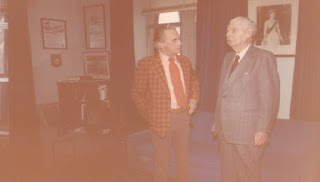
Prime Minister Diefenbaker and my Dad, George Shaw.


Tuesday, March 1, 2022

The Experimental Farms will never be moved or encroached upon.

House of Commons Ottawa June 1, 1951. Winfred Chester Scott McLure (Progressive Conservative): "...I want to say that the experimental farm is one of the finest beauty spots in this beautiful city of Ottawa. It is a place where visitors and tourists should be taken because nowhere in America will you find another to surpass it."

 House of Commons Ottawa July 13, 1956. James Garfield Gardiner (Minister of Agriculture) Liberal: Mr. Gardiner: "There is a discussion about moving part of all of the experimental farm out every time they want to build a new public building in Ottawa. Somebody comes down here and says "We would like to build it on the experimental farm..." We get those suggestions all the time. Discussion comes up every time somebody has a notion of that kind. The government has always taken the position that there is going to be no moving of the experimental farm."

House of Commons Ottawa June 16, 1958. Hon. George James McIlraith (Ottawa West) Liberal: "Mr. Chairman, I wonder if the Minister is now prepared to make the statement he said he would make concerning the policy of the government with respect to building on the central experimental farm."

The Hon. Charles Howard Green: "The policy is that no buildings will be built on the central experimental farm except buildings for the Department of Agriculture."

The Hon. Mr. Mcilraith: "If I may pursue the question a bit further, has the minister come to any conclusion as to what will be done with the land on the experimental farm now occupied by the temporary buildings when they are torn down?"

The Hon. Mr. Green: "I take it that the hon. member for Ottawa West refers to temporary buildings No. 5 and 8. For some years the policy has been that when these temporary buildings are torn down nothing will be constructed on the site."

The location ofTemporary Building No. 8 is now Queen Juliana Park. Temporary Building No. 5 was on the Dow's Lake parking lot.

House of Commons Ottawa August 1, 1958. Hazen Robert Argue (Co-operative Commonwealth Federation-CCF): Mr. Argue: "Mr. Chairman, on item No. 11, the experimental farms services including the central experimental farm, I wonder if the minister could tell the house whether in regard to the central experimental farm it is the policy of his government to maintain that farm in its present location for futher scientific research, and whether there is anything to the rumour that one hears from time to time that because of extensive city development and increasing property values some other use may be made of part of the property now occupied by this farm."

"I would express the hope that the central experimental farm may be kept in its present form and in its present location. I think it is doing tremendous work and is, amongst other things, a most valuable tourist attraction in the capital city. I think it would be in keeping with the view of the Canadian people as well as the people of Ottawa that the central experimental farm be maintained in its present locaton."

Douglas Scott Harkness (Minister of Agriculture) Progressive Conservative: Mr. Harkness: "I am very glad to tell the hon. member for Assiniboia that the central experimental farm is going to be not only retained but expanded. The plans we have, of which there has been some indication in the press, are that the present experimental farm will be used entirely for plant breeding and plant research activities. The animal husbandry branch ...will be established at a new farm which will of course still be part of the central experimental farm, a few miles south and west of the present property in what will be the greenbelt surrounding Ottawa.We expect to secure from the federal district commission something in the neighbourhood of 4,000 acres of land in the greenbelt."

The 4,500 acre Greenbelt Research Farm during the mid-1960's. As I have mentioned before, the land is untouchable because it is a National Interest Land Mass (the Mulroney government, 1988) and the land is part of the National Capital Commission Greenbelt. (Prime Minister Mackenzie King and Jacques Greber, 1949-1950.)

The 1958 Privy Council Order-in-Council giving Agriculture Canada 4,500 acres of Greenbelt land for an annex. 


House of Commons Ottawa October 7, 1974. Walter David Baker (Deputy House Leader of the Official Opposition; Progressive Conservative Party Deputy House Leader) Progressive Conservative. Mr. Walter Baker (Grenville-Carleton): "Mr. Speaker, in view of the statement yesterday by the Minister of State for Urban Affairs about trade-offs in respect of greenspaces in Canadian cities, will he inform the House how this trade-off will affect specifically the experimental farm in the city of Ottawa and the greenbelt surrounding it, and indicate whether the government is now actively planning to intrude development into these areas?"

Hon. Barnett Jerome Danson (Minister of State for Urban Affairs) Liberal: Mr. Barnett J. Danson: "Mr. Speaker, I was just speaking about the general picture in Canada, trying to make people aware of the necessary considerations we have in attempting to deal with growth in our cities. Certainly the city of Ottawa in particular has to be treated with special sensitivity. There will be further discussions on this subject before the special joint committee of the House and Senate announced in the Speech from the Throne, and in respect of other reports which are forthcoming. This will give us ample opportunity to deal with the member's concern, which I share."

House of Commons Ottawa November 4, 1974. Walter David Baker (Deputy House Leader of the Official Opposition; Progressive Conservative Party Deputy House Leader) Progressive Conservative. Mr. Walter Baker (Grenville-Carleton): "Mr. Speaker, on October 7 I directed a question to the Minister of State for Urban Affairs (Mr. Danson) regarding a theory he advanced in the course of 'Question Period', that the government certainly would have to consider a trade-off in respect of green spaces in Canadian cities."
"At that time this indicated that the minister was at least considering the intrusion of development into green spaces. Subsequently the minister, in the course of his answer, indicated that at least in so far as the two places I had mentioned in the National Capital Area, namely the Experimental Farm and the Ottawa green belt, he regarded these as areas of special sensitivity, and shared my view and the view of many other members of the House in respect of the necessity to preserve them."

"I want to say that where we are dealing with the National Capital Area, which is certainly an area of special sensitivity, or with any other urban area in this country, we must regard, and government policy must look at green space in urban areas as a very precious commodity. It is becoming more precious each day as there is a tendency in our society, and in the planning of our society, to pack more and more people onto fewer and fewer acres of land. Municipal development is becoming vertical rather than horizontal. Indeed, we must consider the impact that this type of development will have on open space, and particularly agricultural land. The green belt and the Experimental Farm are precious for the reasons I have mentioned."

"There really is no open or green space available to those who live in high-rise housing, row housing, in condominiums or in densely populated areas. That green and open space which normally is provided by one's backyard, or by the neighbourhood park, must be provided on those urban areas by areas such as the Experimental Farm and green belt.

House of Commons Ottawa May 13, 1988. Mr. David Bruce Daubney (Ottawa West) Progressive Conservative: "Mr. Speaker my question is directed to the Minister of Agriculture. He will agree that the Central Experimental Farm partly located in my riding is the flagship of Agriculture Canada's excellent research effort and contributes greatly to the unique beauty and character of the nation's capital. Will he confirm for the House that the Government has no intention of disposing of any part of the Experimental Farm proper, and in particular that part bordered by Merivale and Fisher Avenues in the city of Ottawa?"

The Hon. John Wise (Minister of Agriculture) Progressive Conservative: "Mr. Speaker, I appreciate the Hon. Member's continuing interest in the future of the Experimental Farm here in Ottawa. I want to take this opportunity to indicate to him that Agriculture Canada, my Department, has no plans or thoughts whatsoever concerning disposing of any portion of that property at any time. There is no question about that....In fact, next to the Parliament Buildings the Experimental Farm is the second most popular tourist attraction here in Ottawa."

Some Hon. Members: "Hear, hear!"